Why we light a tree, and send a card, at the darkest time of the year.
The bottom of the year
Around December 21, the northern half of the world reaches its darkest day. For most of human history that wasn’t just a date on a calendar. It was the bottom of the year. The harvest was half eaten, the fields were bare and nothing was growing. Nobody could be sure the light would come back.
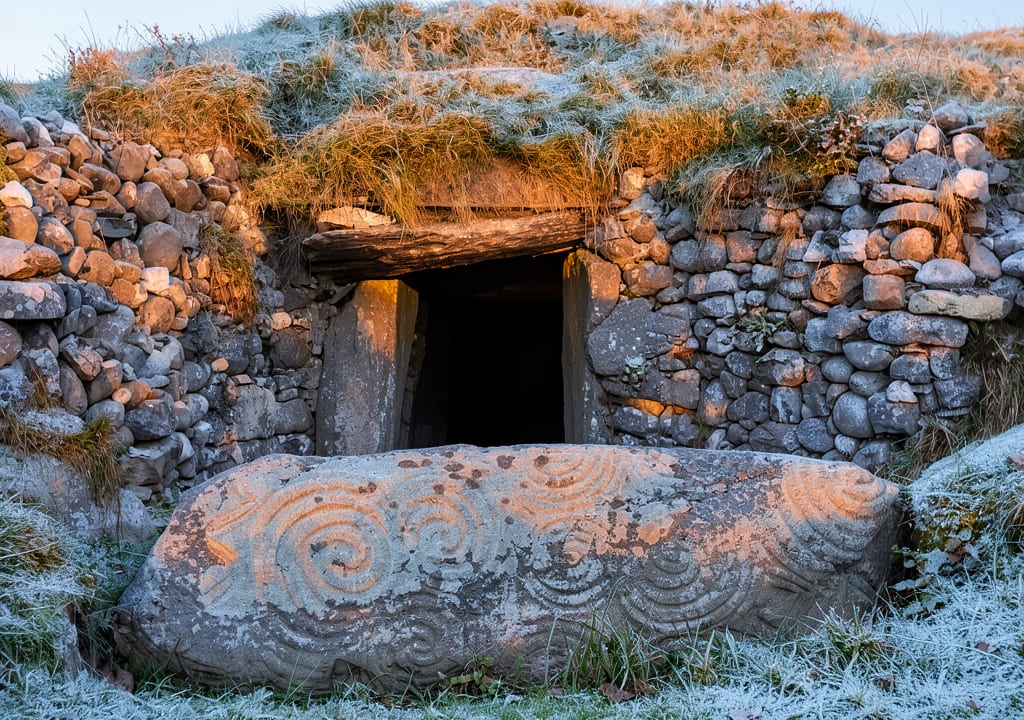
People have answered that darkness the same way for as long as there is any record. About 5,000 years ago, farmers in what is now Ireland built a great stone mound at Newgrange with a small opening above its door. On the mornings around the winter solstice, and only then, the rising sun reaches down a long stone passage and lights the chamber at its heart. Newgrange is older than Stonehenge and older than the pyramids at Giza. Before anyone wrote anything down, people moved tons of stone so that on the darkest morning of the year, the light came in.
The entrance to Newgrange, recreated with AI from a photograph of about 1905.
Light, green and company
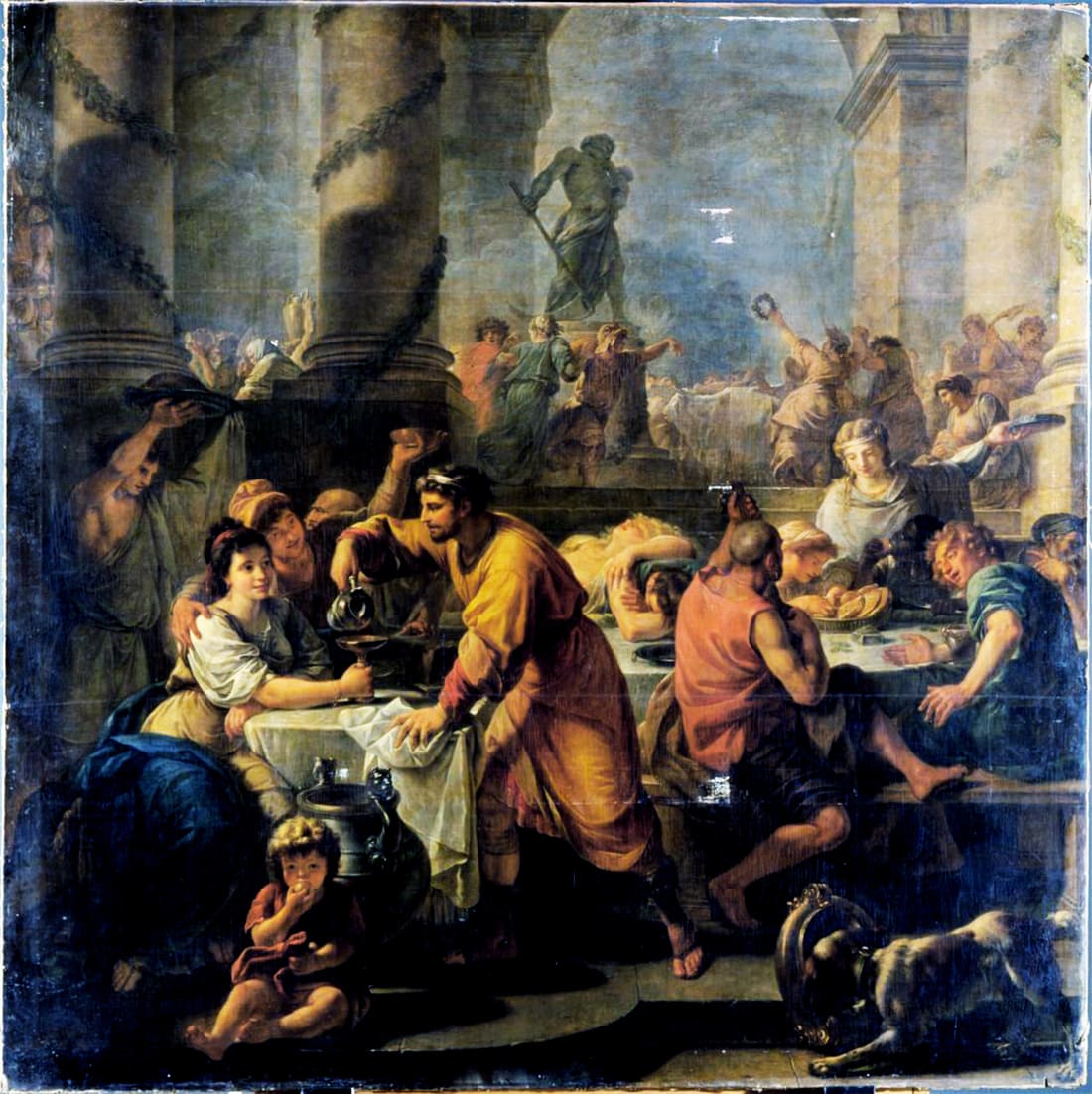
The Romans kept Saturnalia in the same week. They hung their houses with holly and ivy, lit wax candles and gave them as gifts, and set aside a day for small presents. In the north, Yule fell at midwinter, and there was a practical reason to feast. There wasn’t enough fodder to keep every animal through the winter, so the slaughter came now, and the drink made at harvest was ready. People ate together because it was the last plenty before the lean months, and because the lean months were survived together or not at all.
Saturnalia, by Antoine-François Callet, 1783.
A calendar made in Rome in the year 354 marks December 25 as the birth of Christ in Bethlehem. It is the earliest record we have of that date. Christmas took its place at the darkest point of the year and gave the season its central line: “And the light shineth in darkness; and the darkness comprehended it not.”
A tree that stays green
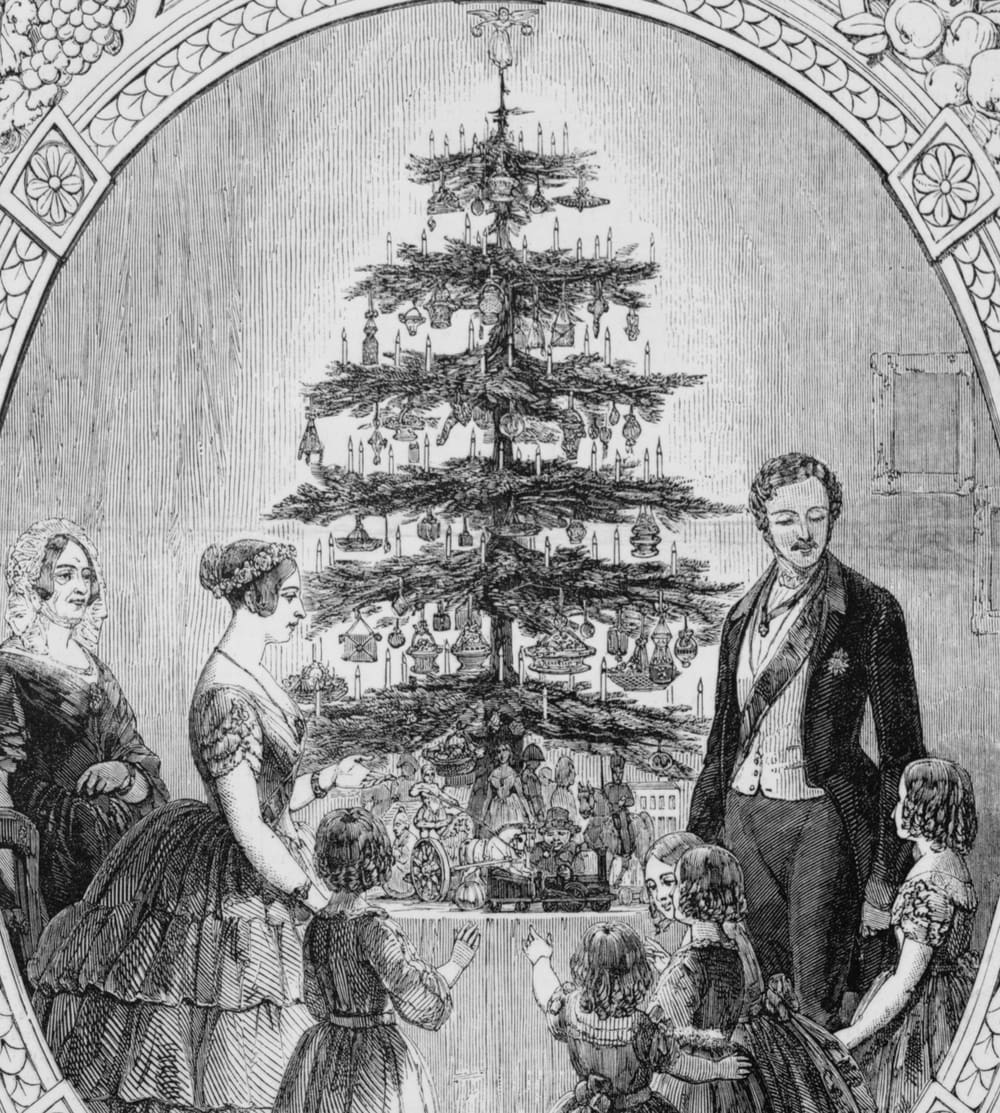
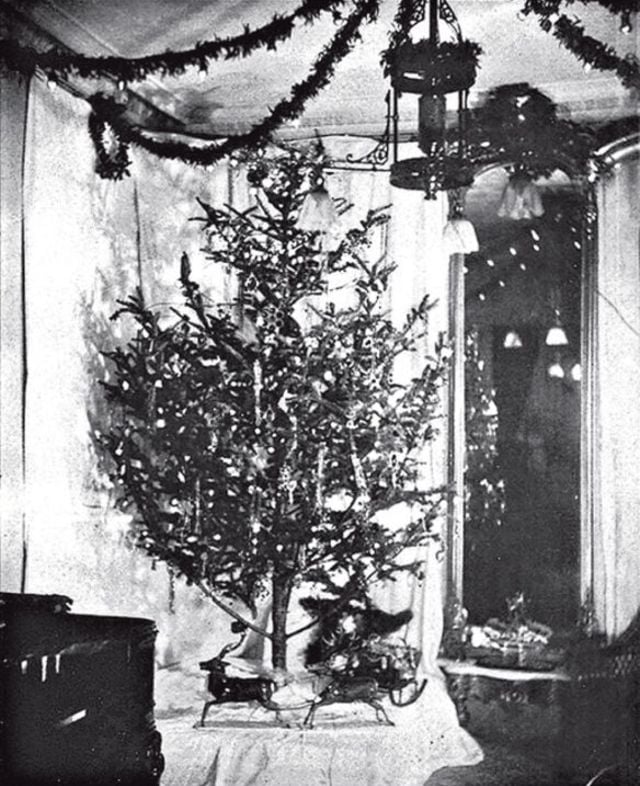
In a winter forest, an evergreen is the one thing still alive. In 1605 a writer in Strasbourg described families setting fir trees up in their parlours at Christmas and hanging them with paper roses, apples, wafers and sugar. The custom spread across German-speaking Europe. In 1848 the Illustrated London News printed an engraving of Queen Victoria and Prince Albert’s family gathered around a decorated tree at Windsor, and within a generation there were trees in parlours across Britain and America. Candles came first. Then, in December 1882, Edward Johnson, one of Thomas Edison’s colleagues, wired the tree in his New York house with electric bulbs.
Christmas Tree at Windsor Castle, by J. L. Williams, from the Illustrated London News, 1848. Library of Congress.Edward Johnson’s tree in his New York house, December 1882: the first lit with electric bulbs. The Henry Ford.
Bringing a living tree indoors in the darkest week of the year and filling it with light is a promise you make to yourself and your children, and you see it every evening. The days will get longer. Things will grow again. The tree stays green. There will be light, and there will be life.
The card
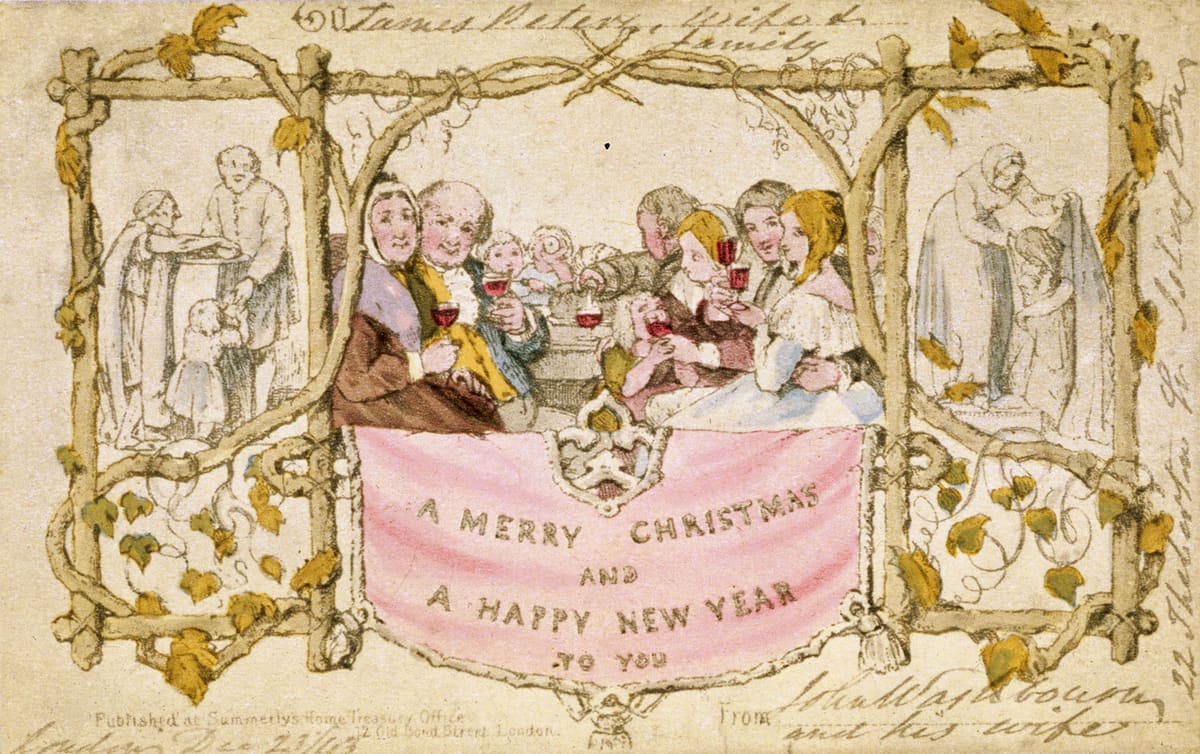
The Christmas card is younger than the tree, and it came out of the post. In 1840 Britain brought in the Penny Post, and anyone could send a letter anywhere in the country for a penny. In 1843 Henry Cole, one of the men behind it, had too many people to write to. He asked the artist John Callcott Horsley to draw a card instead: a family at a table raising a glass, and on either side, people giving food and clothing to those who had none. About a thousand were printed.
The card Henry Cole sent in 1843, drawn by John Callcott Horsley.
In 2003 two anthropologists, Russell Hill and Robin Dunbar, used Christmas card lists to measure how many people a person really keeps in their life. Their reasoning was that sending cards is the one time of year people make the effort to reach everyone whose relationship they value. The average was about 150 people.
A Christmas card list is your community: the people you can be sure of reaching at least once every year.
Why it matters
Those people are much of what keeps us happy, motivated and connected, and what makes a year feel like it meant something. The research suggests they matter even more than that.
A 2010 review of 148 studies, covering more than 300,000 people, found that people with strong social relationships were about 50% more likely to survive over the years they were followed.
In July 1995 a heat wave in Chicago killed more than 700 people. In Heat Wave, Eric Klinenberg compared two neighbourhoods side by side, each with a similar share of old people living alone. North Lawndale lost 19 people. Little Village lost 3. The difference was busy streets and shops where neighbours saw each other.
In Building Resilience, Daniel Aldrich studied recovery after the Tokyo and Kobe earthquakes, the Indian Ocean tsunami and Hurricane Katrina. The communities that came back fastest were the ones whose people were most tied to each other.
The ties that hold in a hard winter are the ones kept up before it.
Social media was supposed to fix this. In 2016 Robin Dunbar, the same anthropologist who counted Christmas card lists, studied Facebook friends. People had about 150 friends there, the same number the card lists found, but on average they could count on about four of them in a crisis. A post is written to everyone, so it’s written to no one in particular. It doesn’t ask anything of the person reading it, and it doesn’t wait for an answer. You can watch a friend’s life scroll past for years and never once hear their voice. A follow isn’t a friendship, and a like isn’t a visit.
A relationship runs both ways, and it lasts only as long as both people keep reaching out. Dunbar and his colleague Sam Roberts followed a group of eighteen-year-olds for a year and a half as they left school for university or work. They grew closer to their families. They drifted from their friends, except where they kept making the effort: talking more, doing more together. It takes more than 200 hours together to make a close friend. Losing one takes nothing but time. Nobody notices it happening until winter comes and there’s no one to call.
The darkness now isn’t the length of the night. It’s the quiet: a light on in every house, and nobody at the door.
One card, every year
A card is a small thing. It costs one evening. But it’s the one moment each year when you reach everyone on that list and tell them: we’re still here, this was our year, we’re thinking of you. Do it every year and the ties hold. Keep the cards and they become a record of a family across decades.
Light the tree. Send the card. The days get longer from here.